


Biology and Origin of Rattan
Rattan is a natural product obtained from the East Asian rattan palm. These palms usually grow wild in the tropical rainforests of Southeast Asia, Africa, and Australia, though almost 90% of all rattan plants are found in Indonesia.
Rattan palms do not look like 'normal' palms; instead, they form lianas that grow into the branches of other trees and hook themselves there with thorns – hence the name climbing palm. Since these lianas do not firmly fuse with the supporting tree, they can slip off repeatedly and then have to regrow – resulting in shoots up to 200 m long, which often lie in coils on the ground.
Extraction and Processing
The core of the woody shoots is also called rattan core. However, only a few of the over 600 different rattan species can be used for making rods, rattan core, and wickerwork. For extraction, the liana strands are cut out of the trees, and the lianas are trimmed, cleaned, and sorted by thickness.
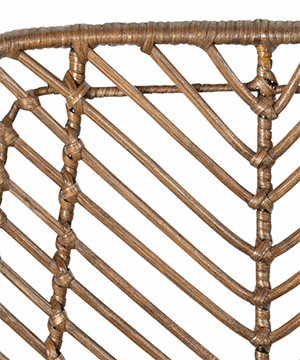 Thick and sturdy parts are processed into poles. From these uncut poles, for example, walking sticks, carpet beaters, canes, bows, martial arts batons, and furniture frames are made.
For weaving material, approximately 5 m long strips are cut from the shoot surface of the lianas and dried. For processing, the material must be soaked; thicker shoots are made pliable with steam or a hot air gun. With these flexible strips, baskets, wicker chairs and armchairs can be woven or other pieces of furniture produced.
The properties of rattan and the use of the lianas are extremely positive both for the manufactured products and for the environment, the biodiversity of the rainforests, and local agriculture in the producing countries.
Rattan is a fast-growing raw material and stores large amounts of CO2. Since the rattan palm cannot be cultivated in plantations but depends on natural forests, its extraction secures the biodiversity of these forests.
The processing of the lianas and the export of the manufactured products provide local farmers with an additional income alongside their primary agriculture.
The products themselves are robust, stable, durable, elastic, and lightweight, making them ideal for furniture production.
Care of Rattan Furniture
To prevent the natural flexibility and elasticity of the wickerwork from being lost, it is advisable to occasionally moisten it with a spray bottle or wipe it with a damp cloth. It is best to use a mixture of water with a little saddle soap or a special care product so that the material does not become stiff and brittle.
When used outdoors, the furniture pieces should be protected from continuous moisture, meaning they should either be placed under a roof or covered with a tarp.
We generally advise against varnishing rattan furniture, as the protective layer can easily become brittle, and moisture can then permanently settle under the varnish residues and damage the material.
Further information on rattan can be found here on Wikipedia.


